In-vivo: tissues and fluids. Insoluble elastin will first require conversion to water soluble α-elastin using the oxalic acid reagent and extraction protocol supplied with the kit.
In-vitro: Elastin produced by cells during 2D/3D cell culture.

F2000 (110 assays)
F4000 (440 assays, MultiPack)
UK & Ireland orders are supplied direct from Northern Ireand. For other locations please order through our distributor network.
Order through your local distributorUK & Ireland customers: order directAt a glance
The kit


Method
Insoluble elastin will first require conversion to water-soluble α-elastin using the oxalic acid reagent and extraction protocol supplied with the kit.
Incubation of samples containing soluble or extracted (solubilised) elastin with the Fastin Dye Reagent causes an elastin-dye complex to form. This insoluble complex then precipitates.
Dye-labelled elastin is isolated by centrifugation and the unbound dye removed. Elastin-bound dye is then eluted and measured spectrophotometrically at 513nm.
The elastin content of unknown samples can be calculated by comparison against a calibration curve prepared using a standard comprising water-soluble elastin (supplied with the kit).
In-vivo: tissues and fluids. Insoluble elastin will first require conversion to water soluble α-elastin using the oxalic acid reagent and extraction protocol supplied with the kit.
In-vitro: Elastin produced by cells during 2D/3D cell culture.
This kit is designed for research use only. Not for use in diagnostic procedures.
Kit requires access to a centrifuge, heated water bath or block, as well as a spectrophotometer or colorimeter capable of absorbance detection at 513nm.
Specific sample preparation protocols may require customer to provide further reagents, consult assay manual for further information.
Background

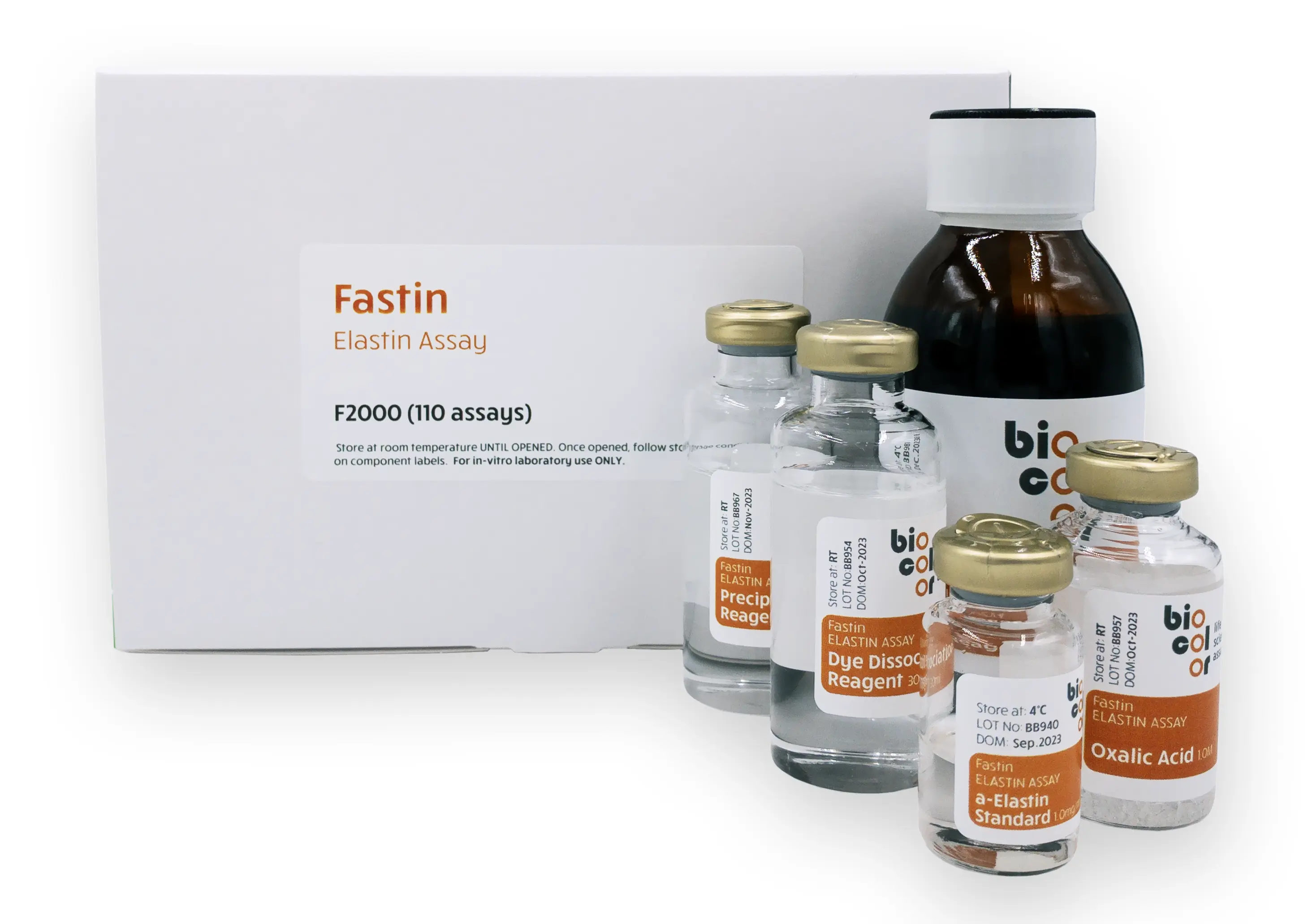
1. Dye Reagent (1x110ml)
2. α-elastin Reference Standard (1x5ml, 1.0 mg/ml soluble Bovine elastin)
3. Oxalic Acid (1x20ml)
4. Dye Dissociation Reagent (1x30ml)
5. Precipitating Reagent (1x30ml)
6. 1.5ml micro-centrifuge tubes for dye-labelling reaction.
7. Assay kit manual
NB: Additional reagents may be required for sample preparation prior to assay. Consult manual or contact us for further details.
Tissues such as lungs, heart and blood vessels need to be able to stretch and recoil repeatedly throughout an organism's life. The protein Elastin is largely responsible for this elasticity. Elastin is initially secreted by elastin-producing cells as a soluble monomeric precursor known as tropoelastin. This undergoes a process of self-assembly and cross-linking with other extracellular matrix components that results in the formation of 'insoluble' elastin fibres.
The Biocolor Fastin assay is a user-friendly, dye-based means of quantifying elastins derived from both in-vivo and in-vitro sources. A variety of elastin forms can be assayed, from the immature tropoelastin to mature ‘insoluble’ elastin fibres.
The Fastin Dye Reagent contains an elastin-binding synthetic porphyrin, TPPS (5,10,15,20-tetraphenyl- 21H,23H-porphine). This affinity of TPPS for elastin was first observed when used as a 'vital stain' on live animals. Most tissues took up the dye initially but only elastin retained the TPPS molecules over time. [Winkelman, J. (1962), Cancer Res. 22, 589-596; Winkelman, J & Spicer, S. (1962), Stain Technol. 37, 303-305].
It has been proposed that the elastin binding of TPPS may be due to the retention of the acidic dye (which contains four charged sulfate groups) by the basic amino acid side chain residues of elastin.
Support
The questions our technical team is asked most about this kit. Not answered here?
Ask us directlySoluble tropoelastins, lathyrogenic elastins and insoluble cross-linked elastins that have been solubilised using hot oxalic acid treatment.
Absorbance peak for TPPS in the dye dissociation reagent is 513nm. However, absorbance settings of 545nm or 550nm also give usable readings. A blue green filter is usually appropriate but filters either side of this should be tested to obtain the highest linear absorbance readings possible.
We recommend that you consult the Fastin Quick-Start guide which contains a useful flowchart to guide you to the relevant sections of the product manual.
The Fastin manual suggests 60-minute extractions to balance efficiency with convenience. Please note that multiple extractions may be required, see p18 of manual for details.
The efficiency of the elastin extraction can be increased by grinding or homogenising the samples prior to addition of the oxalic acid. Practically this can be aided by lyophilisation or snap freezing and grinding of the material in the frozen state. Such material should extract more quickly as the surface area is increased.
The Fastin dye/elastin labelling interaction is most efficient at neutral pH, for this reason the Fastin Dye reagent is supplied in a buffered form. The elastin precipitating reagent has a low pH and if any residual fluid is left, will significantly alter the pH of the sample/dye mixture. This causes a change in the dye colour (from red to green), and a reduction in elastin labelling.
Please ensure that as much fluid is removed as possible at step 5, prior to addition of the Fastin Dye reagent.
Please first check that you have correctly prepared the assay standards (see table on p8 of the Fastin manual).
Check that you are removing as much fluid as possible at step 5, prior to the addition of the Fastin Dye reagent (see the question on green staining for an explanation of why this is important).
The background absorbance can be reduced by ensuring that you remove as much excess precipitating reagent (see step 5) and dye (see steps 9-10) as possible when performing the general protocol (see pages 9-10 of the Fastin manual).
Unopened, all the reagents are stable for 1 year at room temperature. After opening, follow the storage conditions indicated on the label of each component. Do not freeze any kit components.
Lathyrogens are a class of compounds that can cause lathyrism, a condition characterized by connective tissue deformities. These compounds are typically found in food sources, such as legumes of the genus ‘Lathyrus’ which are nutritionally poor, but are sometimes relied upon during times of drought or famine.
These legumes contain the lathyrogenic compound beta-aminopropionitrile (BAPN) (or other aminonitriles) which inhibit the action of the enzyme lysyl oxidase. This disrupts the normal formation of (lysine-derived) cross-links in collagens and elastin – leading to the changes in connective tissue.
The Fastin assay kit can be used to quantify these elastins despite any lathyrogen-induced changes to the normal elastin cross-linking process.
In the literature
Fastin is used most to check elastin after decellularisation, and in cardiovascular / skin research where elastin drives function.
Elastin kept, or deliberately removed.
Elastin loss in disease.
Elastin made by cells.
Elastin boosted by active compounds.
Typical samples
Decellularised tissue · arteries & valves · plaques · skin & explants · fibroblast cultures
Often used with
A curated selection of peer-reviewed work using this kit, chosen to span different tissues, models and questions.
Elevated Asporin expression in human atherosclerotic plaques promotes their stability and reduces the risk for cardiovascular events
Elastin in human carotid endarterectomy plaques. Fastin was used on homogenates of 176 carotid plaques from the Carotid Plaque Imaging Project cohort, showing that plaque asporin levels were associated with elastin content as a marker of plaque stability.
A translational approach to airway reconstruction leveraging decellularized meniscus and cartilage progenitor cells
Elastin in native vs decellularised porcine meniscus. Fastin was used on dried native menisci and the decellularised scaffold, converted to soluble α-elastin with 0.25 M oxalic acid, to confirm elastin had been removed before the scaffold was used for airway reconstruction.
Reinforced biotubes as readily available and regenerative vascular grafts
Elastin content of decellularised vascular grafts. Elastin was quantified in decellularised polycaprolactone-reinforced biotubes alongside collagen and sulfated GAG, with Verhoeff–van Gieson staining used to map distribution, characterising the elastic matrix of a regenerative vascular graft.
Decellularized Aged Bruch's Membrane Confers Unique Biochemical Cues to Retinal Pigment Epithelium for In Vitro Modeling of Age-Related Macular Degeneration
Elastin in native vs decellularised Bruch's membrane. Fastin was used on native and decellularised Bruch's membrane from young and aged human donors, characterising an aged matrix scaffold for in-vitro modelling of age-related macular degeneration.
Enhanced Anti-Photoaging Effects of Adipose-Derived Stem Cell (ADSC) Secretome via Liposomal and Iontophoretic Intradermal Delivery
Dermal elastin in UV-aged skin. Fastin was used to quantify elastin in UV-aged skin, showing that intradermal delivery of adipose-derived stem cell secretome reduced elastin degradation.
Microcalcification and Thoracic Aortopathy: A Window Into Disease Severity
Elastin in human thoracic aortic tissue. Fastin was used on oxalic acid-digested aortic tissue from aneurysm and dissection surgery patients and controls, relating elastin content to tissue stiffness, microcalcification and disease severity.
Next steps
Tell us your sample type and what you want to measure, and we will point you to the right kit. Biocolor kits are sold through local distributors worldwide, and direct to customers within the UK and Ireland.
Find your local distributor, or order direct in the UK and Ireland.
Find your distributor →